
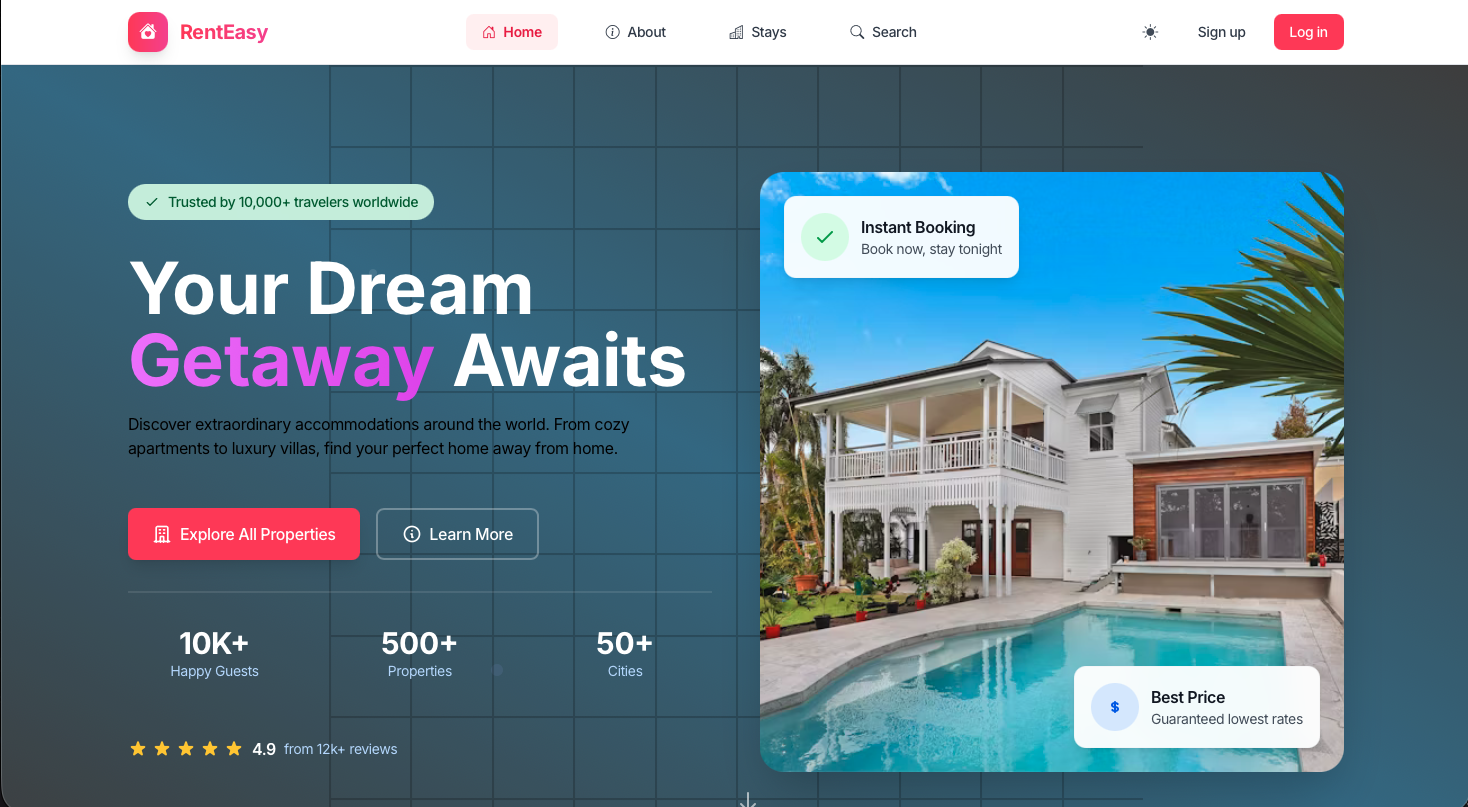
djangoRentEasy
A full-stack Django rental management and booking platform with messaging, filtering, and admin control. Built with Django and Tailwind CSS, deployed on Railway with Cloudinary-hosted static files and PostgreSQL backend.
Project Overview
The Problem
The rental property market suffers from fragmented communication channels, inefficient property discovery, and lack of centralized management tools. Property owners struggle to manage multiple listings, coordinate with prospective tenants, and maintain organized booking workflows. Tenants face difficulty finding suitable properties that match their specific criteria and communicating effectively with property owners. Traditional rental platforms often lack the granular filtering capabilities and integrated messaging systems necessary for efficient property transactions.
The Solution
djangoRentEasy provides a comprehensive rental management platform that centralizes property listings, tenant communication, and booking workflows in a single, cohesive system. The platform enables property owners to manage their entire portfolio through an intuitive dashboard while providing tenants with advanced search capabilities and direct messaging channels. By integrating authentication, role-based access control, and real-time communication features, the application streamlines the entire rental process from property discovery to booking confirmation.
Technical Approach
Built on Django 4.x with PostgreSQL as the persistence layer, the application leverages Django's ORM for complex querysets and relationship management. The frontend utilizes Tailwind CSS for responsive, utility-first styling, while JavaScript enhances interactivity for filtering and messaging interfaces. Static assets and media files are served through Cloudinary for optimized delivery and automatic image transformations. The application is deployed on Railway with environment-based configuration management, automated migrations, and horizontal scaling capabilities.
Core Capabilities
Property Management System
The platform implements full CRUD (Create, Read, Update, Delete) operations for rental listings, with each property containing comprehensive metadata including title, description, location, pricing, availability windows, amenities, and image galleries. Ownership enforcement ensures users can only modify listings they own, while the system maintains referential integrity through Django's model relationships. Properties are displayed in a catalog view with pagination and sorting options for efficient browsing.
Advanced Search and Filtering
A sophisticated filtering system enables tenants to refine property searches using multiple parameters: price ranges, geographic location, room count, and amenity requirements. The filtering logic leverages Django's QuerySet API to build dynamic database queries based on user input, with support for complex AND/OR conditions. Filter state is preserved across navigation, and results update dynamically without full page reloads for improved user experience.
Integrated Messaging Infrastructure
The platform features a bidirectional messaging system that facilitates communication between property owners and prospective tenants. Each conversation is isolated with strict access controls—only participants can view message threads. Messages are stored with sender/receiver relationships, timestamps, and read/unread states. The interface provides scrollable conversation views with real-time updates and notification indicators for new messages.
Role-Based Access Control
The application implements comprehensive authentication and authorization using Django's built-in authentication system. User roles (tenant, owner, admin) determine access to specific features and pages through view-level decorators and middleware. Property owners access dedicated dashboards for managing listings and viewing booking requests, while administrators have full system access through Django's admin interface for user management, content moderation, and system configuration.
Administrative Dashboard
Django's admin interface is customized to provide centralized management of users, properties, bookings, and messages. The admin panel includes custom list displays, filters, and search capabilities for efficient data management. Bulk operations enable administrators to perform actions across multiple records, while audit trails track changes to critical data.
Technical Architecture
Backend Framework and Data Layer
Django serves as the core framework, handling URL routing, view logic, template rendering, and ORM operations. The data model includes Users (extending Django's AbstractUser), Properties, Messages/Conversations, and Bookings, with foreign key relationships establishing ownership and participation. Business logic is encapsulated in model methods and custom managers, enforcing constraints such as booking availability and ownership validation. PostgreSQL provides ACID-compliant data persistence with support for complex queries and transactions.
Frontend and User Interface
The presentation layer combines Django templates with Tailwind CSS for responsive, mobile-first design. JavaScript enhances interactivity through dynamic filtering, asynchronous message updates, and form validation. The interface adapts seamlessly across devices (mobile, tablet, desktop) with breakpoint-specific layouts and touch-optimized controls.
Static Asset Management
Cloudinary serves as the CDN for static assets (CSS, JavaScript) and media files (property images), providing automatic image optimization, responsive image delivery, and global edge caching. Django's static file configuration is customized for production deployment with proper URL resolution and cache-busting strategies.
Deployment Infrastructure
The application is deployed on Railway with environment-based configuration using environment variables for sensitive data (database credentials, API keys, secret keys). Production settings include DEBUG = False, HTTPS enforcement, CSRF protection, and allowed hosts configuration. Automated deployment pipelines handle database migrations, static file collection, and application restarts.
Technical Challenges and Solutions
Challenge: Implementing secure, isolated messaging between users while preventing unauthorized access to conversation threads.
Solution: Enforced strict authorization checks in views using custom decorators that verify user participation in conversations. Model-level relationships ensure data isolation, with querysets filtered by user context.
Challenge: Building a flexible filtering system supporting multiple simultaneous criteria (price, location, amenities) with efficient database queries.
Solution: Implemented custom filter logic using Django's Q objects for complex query construction. Utilized database indexing on frequently filtered fields to maintain query performance at scale.
Challenge: Managing ownership permissions to prevent users from modifying properties they don't own.
Solution: Implemented view-level ownership validation using custom mixins that verify user ownership before allowing modification operations. Model methods encapsulate ownership logic for reusability across the application.
Challenge: Optimizing media delivery and handling image uploads in a production environment.
Solution: Integrated Cloudinary for automatic image optimization, format conversion (WebP), and responsive image delivery. Configured Django's file storage backend to use Cloudinary's API for seamless upload and retrieval.
Challenge: Managing environment-specific configuration and secrets across development and production environments.
Solution: Implemented environment-based settings using Railway's environment variable system. Separated development and production configurations with conditional imports based on environment detection.
Impact and Business Value
djangoRentEasy demonstrates full-stack development proficiency across backend architecture, frontend design, database modeling, and production deployment. The platform provides a foundation for real-world rental management operations with scalable architecture supporting future enhancements. The implementation showcases expertise in building secure, multi-user applications with complex business logic and role-based access control.
Future Development Roadmap
- Payment Integration: Stripe or PayPal integration for secure online rent payments and deposit handling
- Notification System: Email and SMS alerts for booking confirmations, message notifications, and status updates
- Real-Time Communication: WebSocket implementation using Django Channels for instant message delivery
- Enhanced Search: Full-text search using PostgreSQL's full-text capabilities and map-based property visualization
- Review System: Tenant rating and review functionality with moderation capabilities
- Mobile Application: REST API development for native iOS/Android clients
- Analytics Dashboard: Usage metrics, booking trends, and revenue analytics for property owners
- Multi-Language Support: Internationalization (i18n) for global market expansion
Technical Skills Demonstrated
- Full-stack web development with Python and Django
- Database design and PostgreSQL optimization
- RESTful architecture and CRUD operations
- Authentication, authorization, and security best practices
- Responsive design with Tailwind CSS
- Cloud deployment and infrastructure management (Railway, Cloudinary)
- Version control and collaborative development workflows
- Production environment configuration and security hardening