Recursion in JavaScript: The Art of Functions Calling Themselves
On this blog post, we'll dive into the world of recursion in JavaScript. We'll explore what recursion is, when to use it, and some common gotchas.
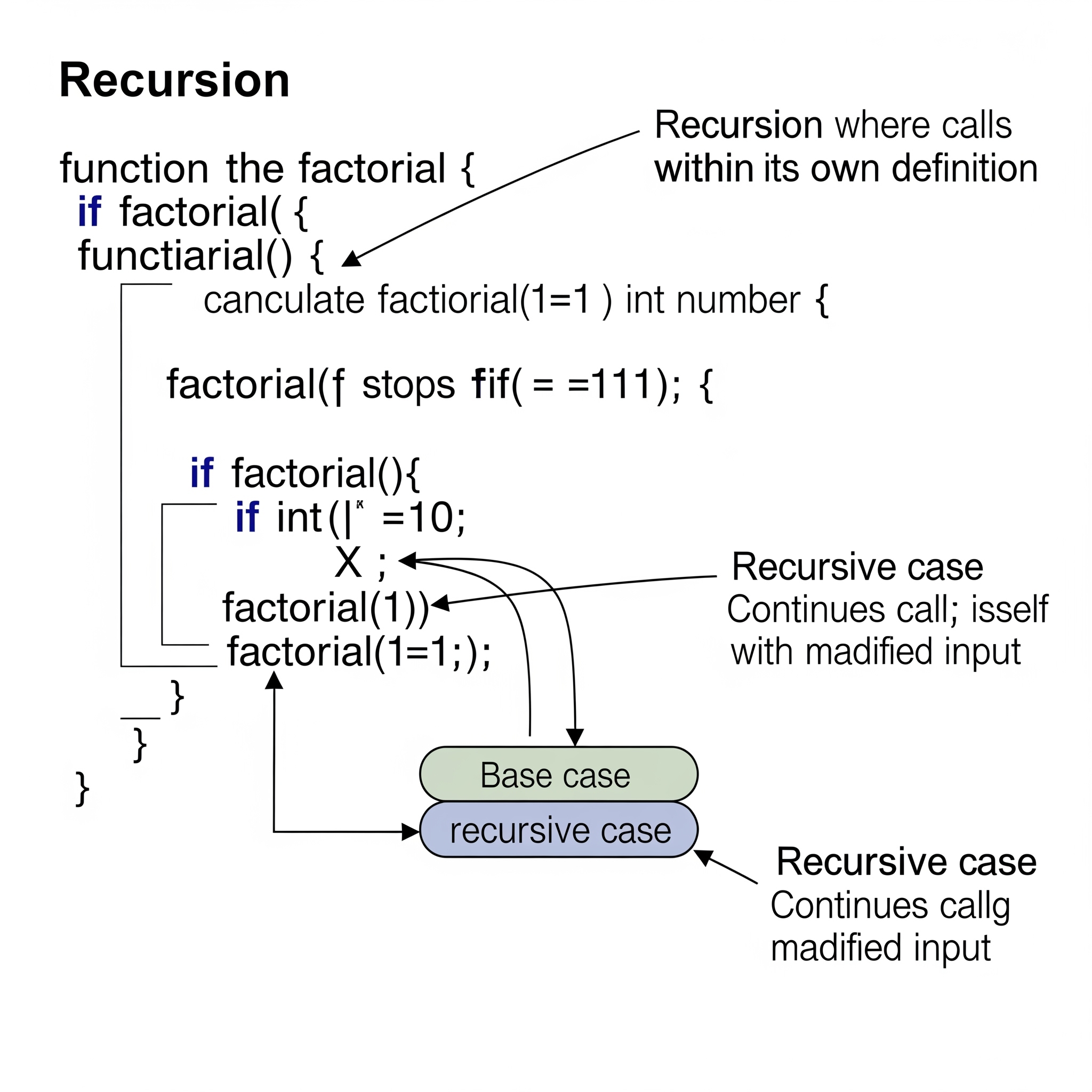
Introduction to Recursion
Recursion is a fundamental programming concept where a function calls itself to solve a problem by breaking it down into smaller, more manageable subproblems. While it may seem counterintuitive at first, recursion is a powerful technique that can lead to elegant solutions for certain types of problems.
In this comprehensive guide, we'll explore recursion in JavaScript, covering the fundamentals, practical applications, performance considerations, and best practices for writing recursive functions.
What Is Recursion?
Recursion is a programming technique where a function calls itself during its execution. This self-referential approach allows complex problems to be solved by repeatedly applying the same logic to progressively simpler versions of the problem.
Every recursive function consists of two essential components:
Base Case
The base case is the terminating condition that stops the recursion. It defines the simplest version of the problem that can be solved directly without further recursion. Without a base case, the function would recurse infinitely, leading to a stack overflow error.
Recursive Case
The recursive case is where the function calls itself with modified arguments, moving closer to the base case with each iteration. This step breaks the problem into smaller subproblems.
Classic Example: Factorial
The factorial of a number n (denoted as n!) is the product of all positive integers less than or equal to n. For example, 5! = 5 × 4 × 3 × 2 × 1 = 120.
function factorial(n) {
// Base case: factorial of 0 is 1
if (n === 0) {
return 1;
}
// Recursive case: n! = n × (n-1)!
return n * factorial(n - 1);
}
console.log(factorial(5)); // Output: 120
console.log(factorial(0)); // Output: 1
console.log(factorial(10)); // Output: 3628800
Execution trace for factorial(5):
factorial(5)
5 * factorial(4)
4 * factorial(3)
3 * factorial(2)
2 * factorial(1)
1 * factorial(0)
returns 1
returns 1 * 1 = 1
returns 2 * 1 = 2
returns 3 * 2 = 6
returns 4 * 6 = 24
returns 5 * 24 = 120
The Call Stack
Understanding the call stack is crucial for understanding recursion. Each function call is added to the call stack, and when a function returns, it's removed from the stack.
function visualizeCallStack(n, indent = '') {
console.log(`${indent}factorial(${n}) called`);
if (n === 0) {
console.log(`${indent}factorial(0) returns 1`);
return 1;
}
const result = n * visualizeCallStack(n - 1, indent + ' ');
console.log(`${indent}factorial(${n}) returns ${result}`);
return result;
}
visualizeCallStack(4);
Output:
factorial(4) called
factorial(3) called
factorial(2) called
factorial(1) called
factorial(0) called
factorial(0) returns 1
factorial(1) returns 1
factorial(2) returns 2
factorial(3) returns 6
factorial(4) returns 24
When to Use Recursion
Recursion is particularly well-suited for specific types of problems:
1. Tree and Graph Traversal
Recursive algorithms naturally express tree and graph traversal logic.
Example: DOM Tree Traversal
function countElements(element) {
let count = 1; // Count current element
// Recursively count children
for (let child of element.children) {
count += countElements(child);
}
return count;
}
// Usage
const totalElements = countElements(document.body);
console.log(`Total DOM elements: ${totalElements}`);
Example: File System Navigation
function findFiles(directory, extension) {
const files = [];
for (let item of directory.contents) {
if (item.type === 'file' && item.name.endsWith(extension)) {
files.push(item.path);
} else if (item.type === 'directory') {
// Recursively search subdirectories
files.push(...findFiles(item, extension));
}
}
return files;
}
2. Divide and Conquer Algorithms
Problems that can be broken into similar subproblems benefit from recursion.
Example: Binary Search
function binarySearch(arr, target, left = 0, right = arr.length - 1) {
// Base case: element not found
if (left > right) {
return -1;
}
const mid = Math.floor((left + right) / 2);
// Base case: element found
if (arr[mid] === target) {
return mid;
}
// Recursive cases
if (arr[mid] > target) {
return binarySearch(arr, target, left, mid - 1);
} else {
return binarySearch(arr, target, mid + 1, right);
}
}
const numbers = [1, 3, 5, 7, 9, 11, 13, 15];
console.log(binarySearch(numbers, 7)); // Output: 3
console.log(binarySearch(numbers, 10)); // Output: -1
Example: Merge Sort
function mergeSort(arr) {
// Base case: arrays with 0 or 1 element are already sorted
if (arr.length <= 1) {
return arr;
}
// Divide the array into two halves
const mid = Math.floor(arr.length / 2);
const left = arr.slice(0, mid);
const right = arr.slice(mid);
// Recursively sort both halves and merge
return merge(mergeSort(left), mergeSort(right));
}
function merge(left, right) {
const result = [];
let leftIndex = 0;
let rightIndex = 0;
// Merge the two sorted arrays
while (leftIndex < left.length && rightIndex < right.length) {
if (left[leftIndex] < right[rightIndex]) {
result.push(left[leftIndex]);
leftIndex++;
} else {
result.push(right[rightIndex]);
rightIndex++;
}
}
// Add remaining elements
return result.concat(left.slice(leftIndex)).concat(right.slice(rightIndex));
}
const unsorted = [64, 34, 25, 12, 22, 11, 90];
console.log(mergeSort(unsorted)); // Output: [11, 12, 22, 25, 34, 64, 90]
3. Dynamic Programming Problems
Many dynamic programming problems have natural recursive formulations.
Example: Fibonacci Sequence
// Basic recursive approach (inefficient)
function fibonacci(n) {
if (n <= 1) {
return n;
}
return fibonacci(n - 1) + fibonacci(n - 2);
}
// Optimized with memoization
function fibonacciMemo(n, memo = {}) {
if (n in memo) {
return memo[n];
}
if (n <= 1) {
return n;
}
memo[n] = fibonacciMemo(n - 1, memo) + fibonacciMemo(n - 2, memo);
return memo[n];
}
console.log(fibonacci(10)); // Output: 55 (slower)
console.log(fibonacciMemo(40)); // Output: 102334155 (much faster)
4. Nested Data Structures
Recursion excels at processing nested structures of unknown depth.
Example: Flattening Nested Arrays
function flatten(arr) {
const result = [];
for (let item of arr) {
if (Array.isArray(item)) {
// Recursively flatten nested arrays
result.push(...flatten(item));
} else {
result.push(item);
}
}
return result;
}
const nested = [1, [2, [3, [4, 5]], 6], 7, [8, 9]];
console.log(flatten(nested)); // Output: [1, 2, 3, 4, 5, 6, 7, 8, 9]
Example: Deep Cloning Objects
function deepClone(obj) {
// Handle null and non-objects
if (obj === null || typeof obj !== 'object') {
return obj;
}
// Handle Date objects
if (obj instanceof Date) {
return new Date(obj.getTime());
}
// Handle Array objects
if (Array.isArray(obj)) {
return obj.map(item => deepClone(item));
}
// Handle plain objects
const clonedObj = {};
for (let key in obj) {
if (obj.hasOwnProperty(key)) {
clonedObj[key] = deepClone(obj[key]);
}
}
return clonedObj;
}
const original = {
name: 'John',
age: 30,
address: {
city: 'New York',
coordinates: {
lat: 40.7128,
lng: -74.0060
}
},
hobbies: ['reading', 'coding']
};
const cloned = deepClone(original);
cloned.address.city = 'Boston';
console.log(original.address.city); // Output: 'New York' (unchanged)
console.log(cloned.address.city); // Output: 'Boston'
5. Backtracking Problems
Backtracking algorithms naturally use recursion to explore all possible solutions.
Example: Generating Permutations
function permute(arr) {
const result = [];
function backtrack(current, remaining) {
// Base case: no more elements to add
if (remaining.length === 0) {
result.push([...current]);
return;
}
// Try each remaining element
for (let i = 0; i < remaining.length; i++) {
current.push(remaining[i]);
backtrack(
current,
[...remaining.slice(0, i), ...remaining.slice(i + 1)]
);
current.pop(); // Backtrack
}
}
backtrack([], arr);
return result;
}
console.log(permute([1, 2, 3]));
// Output: [[1,2,3], [1,3,2], [2,1,3], [2,3,1], [3,1,2], [3,2,1]]
Example: N-Queens Problem
function solveNQueens(n) {
const solutions = [];
const board = Array(n).fill().map(() => Array(n).fill('.'));
function isValid(row, col) {
// Check column
for (let i = 0; i < row; i++) {
if (board[i][col] === 'Q') return false;
}
// Check diagonal (top-left to bottom-right)
for (let i = row - 1, j = col - 1; i >= 0 && j >= 0; i--, j--) {
if (board[i][j] === 'Q') return false;
}
// Check diagonal (top-right to bottom-left)
for (let i = row - 1, j = col + 1; i >= 0 && j < n; i--, j++) {
if (board[i][j] === 'Q') return false;
}
return true;
}
function backtrack(row) {
// Base case: all queens placed
if (row === n) {
solutions.push(board.map(r => r.join('')));
return;
}
// Try placing queen in each column
for (let col = 0; col < n; col++) {
if (isValid(row, col)) {
board[row][col] = 'Q';
backtrack(row + 1);
board[row][col] = '.'; // Backtrack
}
}
}
backtrack(0);
return solutions;
}
console.log(solveNQueens(4));
// Output: [
// [".Q..", "...Q", "Q...", "..Q."],
// ["..Q.", "Q...", "...Q", ".Q.."]
// ]
Common Pitfalls and How to Avoid Them
1. Missing Base Case
A recursive function without a base case will recurse infinitely until the call stack is exceeded.
// BAD: No base case
function infiniteRecursion(n) {
console.log(n);
return infiniteRecursion(n - 1); // Never stops!
}
// GOOD: Proper base case
function countdown(n) {
if (n < 0) {
return; // Base case
}
console.log(n);
countdown(n - 1);
}
2. Stack Overflow Errors
JavaScript has a limited call stack size (typically 10,000-50,000 calls depending on the engine). Deep recursion can exceed this limit.
// This will crash with very large n
function factorial(n) {
if (n === 0) return 1;
return n * factorial(n - 1);
}
// factorial(100000) → RangeError: Maximum call stack size exceeded
Solution: Use Iteration or Tail Call Optimization
// Iterative approach
function factorialIterative(n) {
let result = 1;
for (let i = 2; i <= n; i++) {
result *= i;
}
return result;
}
// Tail-recursive approach (optimized in some engines)
function factorialTail(n, accumulator = 1) {
if (n === 0) return accumulator;
return factorialTail(n - 1, n * accumulator);
}
3. Inefficient Recursion
Some recursive algorithms recalculate the same values multiple times, leading to exponential time complexity.
// BAD: O(2^n) time complexity
function fibonacci(n) {
if (n <= 1) return n;
return fibonacci(n - 1) + fibonacci(n - 2);
}
// fibonacci(40) takes several seconds!
Solutions:
Memoization (Top-Down Dynamic Programming)
function fibonacciMemo(n, memo = new Map()) {
if (n <= 1) return n;
if (memo.has(n)) {
return memo.get(n);
}
const result = fibonacciMemo(n - 1, memo) + fibonacciMemo(n - 2, memo);
memo.set(n, result);
return result;
}
// fibonacciMemo(40) is instant!
Tabulation (Bottom-Up Dynamic Programming)
function fibonacciTabulation(n) {
if (n <= 1) return n;
const dp = [0, 1];
for (let i = 2; i <= n; i++) {
dp[i] = dp[i - 1] + dp[i - 2];
}
return dp[n];
}
4. Incorrect Argument Modification
Make sure recursive calls actually progress toward the base case.
// BAD: n never changes
function broken(n) {
if (n === 0) return;
console.log(n);
broken(n); // Infinite recursion!
}
// GOOD: n decreases each time
function working(n) {
if (n === 0) return;
console.log(n);
broken(n - 1); // Progress toward base case
}
Tail Call Optimization
Tail call optimization (TCO) is a technique where a recursive call in tail position (the last operation before returning) can reuse the current stack frame instead of creating a new one.
What is a Tail Call?
A tail call occurs when a function's last action is to call another function (or itself) and return that function's result directly.
// Tail call: factorial call is the last operation
function factorialTail(n, acc = 1) {
if (n === 0) return acc;
return factorialTail(n - 1, n * acc); // Tail call
}
// NOT a tail call: multiplication happens after the recursive call
function factorialNotTail(n) {
if (n === 0) return 1;
return n * factorialNotTail(n - 1); // Not a tail call
}
TCO in JavaScript
ECMAScript 2015 (ES6) includes tail call optimization in the specification, but most JavaScript engines don't fully implement it. Safari's JavaScriptCore is one exception.
Current Status:
- Safari/WebKit: Supports TCO
- Chrome/V8: Does not support TCO
- Firefox/SpiderMonkey: Does not support TCO
- Node.js: Does not support TCO
Converting to Tail-Recursive Form
// Non-tail-recursive
function sum(n) {
if (n === 0) return 0;
return n + sum(n - 1);
}
// Tail-recursive with accumulator
function sumTail(n, acc = 0) {
if (n === 0) return acc;
return sumTail(n - 1, acc + n);
}
Trampoline Pattern
Since TCO isn't widely supported, you can use the trampoline pattern to avoid stack overflow:
function trampoline(fn) {
return function(...args) {
let result = fn(...args);
while (typeof result === 'function') {
result = result();
}
return result;
};
}
function sumTrampoline(n, acc = 0) {
if (n === 0) return acc;
return () => sumTrampoline(n - 1, acc + n);
}
const sum = trampoline(sumTrampoline);
console.log(sum(100000)); // No stack overflow!
Recursion vs Iteration
Both recursion and iteration can solve the same problems. Here's when to use each:
Use Recursion When:
- The problem has a natural recursive structure (trees, graphs)
- Code clarity matters more than raw performance
- The recursion depth is manageable (< 1000 calls typically)
- Backtracking or multiple branching is involved
Use Iteration When:
- Performance is critical (no function call overhead)
- The recursion depth could be very large
- Memory usage is a concern (no call stack growth)
- The iterative solution is equally clear
Comparison Example
Recursive:
function sumRecursive(arr, index = 0) {
if (index >= arr.length) return 0;
return arr[index] + sumRecursive(arr, index + 1);
}
Iterative:
function sumIterative(arr) {
let total = 0;
for (let num of arr) {
total += num;
}
return total;
}
For simple aggregations like summing an array, iteration is clearer and more efficient. For traversing a tree, recursion is typically clearer.
Advanced Recursion Patterns
Mutual Recursion
Two or more functions call each other recursively.
function isEven(n) {
if (n === 0) return true;
return isOdd(n - 1);
}
function isOdd(n) {
if (n === 0) return false;
return isEven(n - 1);
}
console.log(isEven(10)); // Output: true
console.log(isOdd(10)); // Output: false
Recursive Data Structures
Structures that contain references to structures of the same type.
class TreeNode {
constructor(value) {
this.value = value;
this.left = null;
this.right = null;
}
}
function sumTree(node) {
if (node === null) return 0;
return node.value + sumTree(node.left) + sumTree(node.right);
}
function maxDepth(node) {
if (node === null) return 0;
return 1 + Math.max(maxDepth(node.left), maxDepth(node.right));
}
// Create a tree
const root = new TreeNode(10);
root.left = new TreeNode(5);
root.right = new TreeNode(15);
root.left.left = new TreeNode(3);
root.left.right = new TreeNode(7);
console.log(sumTree(root)); // Output: 40
console.log(maxDepth(root)); // Output: 3
Recursive Generators
Generators can be used recursively to yield values lazily.
function* fibonacciGenerator() {
function* fib(a = 0, b = 1) {
yield a;
yield* fib(b, a + b);
}
yield* fib();
}
const fibonacci = fibonacciGenerator();
for (let i = 0; i < 10; i++) {
console.log(fibonacci.next().value);
}
// Output: 0, 1, 1, 2, 3, 5, 8, 13, 21, 34
Debugging Recursive Functions
Visualization Techniques
1. Console Logging with Indentation
function factorial(n, depth = 0) {
const indent = ' '.repeat(depth);
console.log(`${indent}factorial(${n}) called`);
if (n === 0) {
console.log(`${indent}factorial(0) returns 1`);
return 1;
}
const result = n * factorial(n - 1, depth + 1);
console.log(`${indent}factorial(${n}) returns ${result}`);
return result;
}
2. Call Stack Tracking
function trackCalls(fn, name) {
const calls = [];
return function tracked(...args) {
calls.push({ name, args });
const result = fn(...args);
console.log('Call stack:', calls);
calls.pop();
return result;
};
}
const trackedFactorial = trackCalls(factorial, 'factorial');
trackedFactorial(4);
3. Using the Debugger
Set breakpoints in your recursive function and step through the call stack in browser developer tools or Node.js debugger.
function debugRecursion(n) {
debugger; // Execution pauses here
if (n === 0) return 1;
return n * debugRecursion(n - 1);
}
Best Practices
1. Always Define a Clear Base Case
Make your terminating condition explicit and easy to identify.
// GOOD: Clear base case
function power(base, exponent) {
if (exponent === 0) return 1; // Clear base case
return base * power(base, exponent - 1);
}
2. Ensure Progress Toward Base Case
Each recursive call should move closer to the base case.
// GOOD: n decreases each call
function countdown(n) {
if (n <= 0) return;
console.log(n);
countdown(n - 1); // Progress toward 0
}
3. Use Memoization
Cache results to avoid redundant calculations for overlapping subproblems.
const memoize = (fn) => {
const cache = new Map();
return (...args) => {
const key = JSON.stringify(args);
if (cache.has(key)) return cache.get(key);
const result = fn(...args);
cache.set(key, result);
return result;
};
};
const fibonacci = memoize((n) => {
if (n <= 1) return n;
return fibonacci(n - 1) + fibonacci(n - 2);
});
4. Consider Iteration for Simple Cases
Don't use recursion if a simple loop is clearer.
// Recursion is overkill here
function sumArray(arr, index = 0) {
if (index >= arr.length) return 0;
return arr[index] + sumArray(arr, index + 1);
}
// Iteration is better
function sumArray(arr) {
return arr.reduce((sum, num) => sum + num, 0);
}
5. Add Input Validation
Validate inputs to prevent unexpected behavior.
function factorial(n) {
if (typeof n !== 'number' || n < 0 || !Number.isInteger(n)) {
throw new Error('Input must be a non-negative integer');
}
if (n === 0) return 1;
return n * factorial(n - 1);
}
6. Document Recursive Logic
Add comments explaining the recursive strategy.
/**
* Calculates the nth Fibonacci number using recursion with memoization
* @param {number} n - The position in the Fibonacci sequence (0-indexed)
* @param {Map} memo - Cache of previously calculated values
* @returns {number} The nth Fibonacci number
*
* Time Complexity: O(n) with memoization
* Space Complexity: O(n) for memoization cache
*/
function fibonacci(n, memo = new Map()) {
if (n <= 1) return n;
if (memo.has(n)) return memo.get(n);
const result = fibonacci(n - 1, memo) + fibonacci(n - 2, memo);
memo.set(n, result);
return result;
}
Real-World Applications
JSON Path Finder
Find all paths to a specific value in a nested JSON structure.
function findPaths(obj, target, currentPath = []) {
const paths = [];
for (let key in obj) {
if (!obj.hasOwnProperty(key)) continue;
const newPath = [...currentPath, key];
const value = obj[key];
if (value === target) {
paths.push(newPath);
} else if (typeof value === 'object' && value !== null) {
paths.push(...findPaths(value, target, newPath));
}
}
return paths;
}
const data = {
user: {
name: 'Alice',
settings: {
theme: 'dark',
notifications: {
email: 'enabled',
push: 'enabled'
}
}
},
admin: {
permissions: {
level: 'enabled'
}
}
};
console.log(findPaths(data, 'enabled'));
// Output: [
// ['user', 'settings', 'notifications', 'email'],
// ['user', 'settings', 'notifications', 'push'],
// ['admin', 'permissions', 'level']
// ]
Directory Size Calculator
Calculate the total size of a directory recursively.
const fs = require('fs');
const path = require('path');
function getDirectorySize(dirPath) {
let totalSize = 0;
const items = fs.readdirSync(dirPath);
for (let item of items) {
const itemPath = path.join(dirPath, item);
const stats = fs.statSync(itemPath);
if (stats.isFile()) {
totalSize += stats.size;
} else if (stats.isDirectory()) {
totalSize += getDirectorySize(itemPath); // Recursive call
}
}
return totalSize;
}
// Usage
const sizeInBytes = getDirectorySize('/path/to/directory');
const sizeInMB = (sizeInBytes / (1024 * 1024)).toFixed(2);
console.log(`Directory size: ${sizeInMB} MB`);
React Component Tree Traversal
Find all components of a specific type in a React component tree.
function findComponentsByType(element, targetType) {
const found = [];
function traverse(node) {
if (!node) return;
// Check if this node matches the target type
if (node.type === targetType) {
found.push(node);
}
// Recursively search children
if (node.props && node.props.children) {
React.Children.forEach(node.props.children, traverse);
}
}
traverse(element);
return found;
}
Performance Considerations
Time Complexity Analysis
Recursive algorithms can have varying time complexities:
- Linear Recursion: O(n) - factorial, countdown
- Binary Recursion: O(2^n) - naive Fibonacci
- Logarithmic Recursion: O(log n) - binary search
- Linearithmic Recursion: O(n log n) - merge sort
Space Complexity
Recursive functions use stack space:
- Each recursive call adds a frame to the call stack
- Space complexity is typically O(depth of recursion)
- Deep recursion can lead to stack overflow
Optimization Strategies
- Memoization: Cache results to avoid recalculation
- Tail Call Optimization: Use tail-recursive form when supported
- Convert to Iteration: Use loops for deep recursion
- Trampoline Pattern: Simulate TCO manually
- Limit Recursion Depth: Add depth checks for safety
function deepRecursion(n, maxDepth = 10000) {
if (n <= 0) return 0;
if (maxDepth <= 0) {
throw new Error('Maximum recursion depth exceeded');
}
return n + deepRecursion(n - 1, maxDepth - 1);
}
Summary
Recursion is a powerful programming technique that allows functions to solve problems by breaking them into smaller subproblems. While it can lead to elegant solutions, it requires careful consideration of base cases, stack depth, and performance implications.
Key Takeaways:
- Every recursive function needs a base case to terminate
- Recursive calls should progress toward the base case
- Recursion is ideal for tree-like structures and divide-and-conquer problems
- Watch out for stack overflow with deep recursion
- Use memoization to optimize recursive algorithms with overlapping subproblems
- Consider iteration when recursion depth could be problematic
- Understanding the call stack is crucial for debugging recursive functions Recursion is not about being clever but about thinking in terms of self-similar subproblems. With practice, recursive thinking becomes a natural part of your problem-solving toolkit, enabling elegant solutions to complex problems.
Additional Resources
Learning Resources:
Practice Problems:
Advanced Topics:
Happy coding!