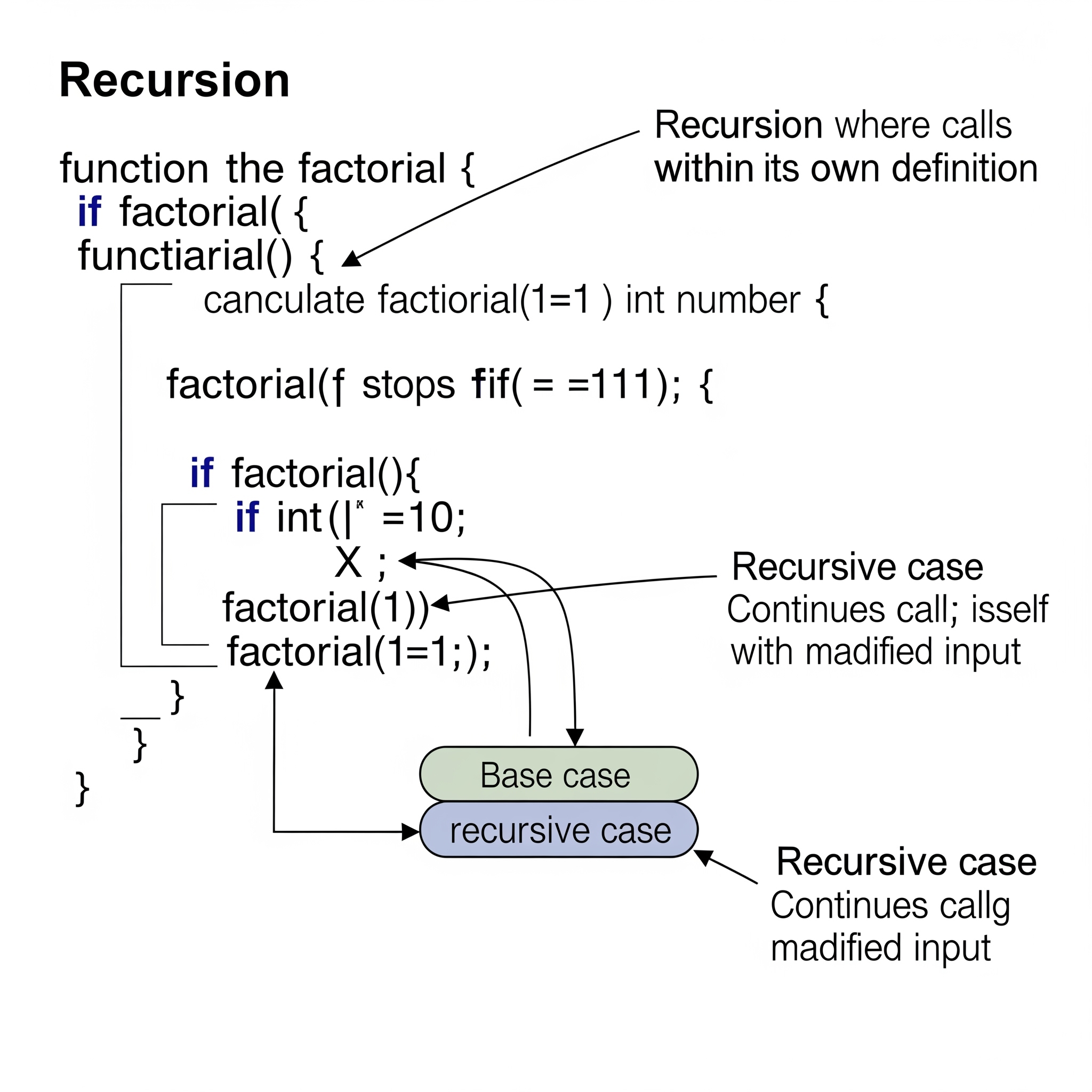
Recursion finally clicked for me: here’s how
Storytime: I spent an embarrassing amount of time “understanding” recursion without actually understanding it. I could parrot the definition, nod along to the factorial example, and then completely freeze when I hit a real problem that needed it.
What finally made it click was not a cleverer explanation. It was realizing recursion is just a function that trusts its future self to handle a smaller version of the same problem.
Let me show you what I mean.
The two things every recursive function needs
Before anything else: every recursive function needs exactly two things, and if either is missing, you are in trouble.
1. A base case: The condition that makes it stop. No base case means infinite recursion, stack overflow, and a crash.
2. Progress toward that base case: Each recursive call must work with a smaller or simpler version of the problem. If the argument never changes, you loop forever.
Here is the classic example, factorial, but let’s trace what is actually happening:
function factorial(n) {
  if (n === 0) return 1; // base case
  return n * factorial(n - 1); // recursive case, as n shrinks each time
}
When you call factorial(4), JavaScript does not evaluate this all at once. It stacks up calls, waits for the base case to resolve, and then unwinds:
factorial(4)
  4 * factorial(3)
       3 * factorial(2)
            2 * factorial(1)
                 1 * factorial(0)
                      -> 1         // base case hit
                 -> 1
            -> 2
       -> 6
  -> 24
Each call waits for the call below it to finish. That is the call stack at work. Understanding this unwinding behavior is the key to reading and debugging recursive code.
Where recursion actually shines
Here is the honest answer to when you should use recursion: when your data is shaped like a tree.
Nested objects, file systems, DOM trees, and component hierarchies all have an unknown depth that you cannot know ahead of time. A loop cannot navigate them cleanly, but recursion can.
Flattening a deeply nested array:
function flatten(arr) {
  const result = [];
  for (let item of arr) {
    if (Array.isArray(item)) {
      result.push(...flatten(item)); // recurse on nested arrays
    } else {
      result.push(item);
    }
  }
  return result;
}

const nested = [1, [2, [3, [4, 5]], 6], 7];
console.log(flatten(nested)); // [1, 2, 3, 4, 5, 6, 7]
Notice that we do not know how deep the nesting goes. A standard for loop cannot handle that, but recursion handles it naturally.
Deep cloning an object:
function deepClone(obj) {
  if (obj === null || typeof obj !== "object") return obj;
  if (Array.isArray(obj)) return obj.map((item) => deepClone(item));

  const clone = {};
  for (let key in obj) {
    if (obj.hasOwnProperty(key)) {
      clone[key] = deepClone(obj[key]); // recurse into each value
    }
  }
  return clone;
}
Same idea: we cannot know the depth of the object ahead of time. Let each call handle one level, and trust the recursion to handle the rest.
Traversing a tree (this comes up constantly with binary trees, React component trees, and file systems):
class TreeNode {
  constructor(value) {
    this.value = value;
    this.left = null;
    this.right = null;
  }
}

function sumTree(node) {
  if (node === null) return 0; // base case
  return node.value + sumTree(node.left) + sumTree(node.right);
}
Three lines of logic without manual stack management. This is where recursion is highly effective.
The pitfall that gets everyone: Fibonacci without memoization
Here is where recursion goes wrong. The naive Fibonacci implementation looks elegant:
function fib(n) {
  if (n <= 1) return n;
  return fib(n - 1) + fib(n - 2);
}
But call fib(40) and watch your browser freeze. The problem is that it recalculates the same values repeatedly. fib(38) gets computed twice, fib(37) four times, and fib(10) hundreds of times.
Fix it with memoization, which caches results you’ve already computed:
function fib(n, memo = new Map()) {
  if (n <= 1) return n;
  if (memo.has(n)) return memo.get(n); // already solved this one

  const result = fib(n - 1, memo) + fib(n - 2, memo);
  memo.set(n, result);
  return result;
}
fib(40) is now instant. It is the same logic and structure, but it remembers what has already been done.
A reusable memoize wrapper if you want it:
const memoize = (fn) => {
  const cache = new Map();
  return (...args) => {
    const key = JSON.stringify(args);
    if (cache.has(key)) return cache.get(key);
    const result = fn(...args);
    cache.set(key, result);
    return result;
  };
};
Watch out for stack overflow
JavaScript’s call stack has a limit, roughly 10,000 to 50,000 frames depending on the engine. Deep recursion can blow past it.
factorial(100000); // RangeError: Maximum call stack size exceededFor problems with potentially deep recursion, the iterative version is usually safer:
// Recursive: can overflow for large n
function factorial(n) {
  if (n === 0) return 1;
  return n * factorial(n - 1);
}

// Iterative: no stack risk
function factorial(n) {
  let result = 1;
  for (let i = 2; i <= n; i++) result *= i;
  return result;
}
The recursive version is easier to read, but the iterative version will not crash. For most real-world inputs, the recursive one is fine, but it is important to know the tradeoff.
When to reach for recursion vs. a loop
I use this as my decision rule: if the data structure has a natural tree shape (nested, branching, unknown depth), reach for recursion. If it is a flat list or you are doing simple aggregation, a loop is clearer.
// Use a loop: this is just summing a flat array
const sum = arr.reduce((total, n) => total + n, 0);

// Use recursion: depth is unknown, structure is nested
function findInTree(node, target) {
  if (!node) return null;
  if (node.value === target) return node;
  return findInTree(node.left, target) || findInTree(node.right, target);
}
Recursion is not better than loops. It is the right tool for tree-shaped problems, but a confusing one for flat problems where iteration is obvious.
Go find a recursive problem
The best way to get comfortable with recursion is to write it. Grab a nested data structure, such as a JSON config file, a DOM subtree, or a folder of files, and try to traverse or transform it recursively.
Start by identifying the base case first. Always. Then ask: what is the simplest thing I can hand off to a recursive call? Once you can answer those two questions naturally, recursion stops feeling like a trick and starts feeling like a tool.
Go build something and test your call stack. It is a rite of passage.